C++ Coroutines — In Depth 🔎
by Gonçalo Ferreira
Table of Contents
- Some Quick Basics
- A Beautiful and Simple Coroutine - std::generator
- Our First Coroutine
- Yielding a Value Out Of a Coroutine - co_yield
- Revisiting our Basic Coroutine - co_return
- Getting a Value Into the Coroutine - co_await
- Some More Details So You Can Have Even More Fun
- References
Some Quick Basics
This is probably not the first post you read about coroutines, so let’s quickly run through the basics:
- A coroutine is basically a function that can be paused and resumed
- Any function containing one or more of the keywords
co_yield,co_await, orco_returnis considered a coroutine - That’s all, let’s just jump in
A Beautiful and Simple Coroutine - std::generator
Before diving deep, let’s look at a very nice coroutine. (If you don’t think it’s nice, wait until you see what’s coming next.)
Don’t worry about any details here, just look at how nice it is to write and use.
1
2
3
4
5
6
7
8
9
10
11
12
13
14
15
16
17
18
19
20
#include <print>
#include <generator> // since C++23

std::generator<int> fibonacci_numbers() {
    int a = 0, b = 1;
    while (true) {
        co_yield a;
        auto next = a + b;
        a = b;
        b = next;
    }
}

int main() {
    auto fib = fibonacci_numbers();
    for (auto num : fib) { // infinite loop
        std::println("{}", num);
    }
    return 0;
}
First, we know fibonacci_numbers() is a coroutine because it has the co_yield keyword somewhere inside.
In coroutines lingo, it’s called a generator. Essentially, it’s a coroutine that keeps outputting (yielding) values.
Something that might be confusing is line 15. It looks like a function call, but
remember that fibonacci_numbers() is not really a function - it’s a coroutine.
In reality, that line is lazy, it does not execute any code inside fibonacci_numbers(),
it only returns a sort of handle that we can use later to interact
with the coroutine (like we do in line 16).
Also, notice how we can use the fib handle as a range, pretty cool.
By the end of this post, you will know how to implement your own std::generator.
Our First Coroutine
Let’s start simple:
1
2
3
4
5
6
7
8
9
10
11
12
#include <print>

void f() {
    std::println("Hello coro");
    co_return;
}

int main() {
    std::println("Hello main");
    auto handle = f();
    return 0;
}
f() is a coroutine because it has the co_return keyword inside.
Now, if we try to compile it we get an error (with a nice message).
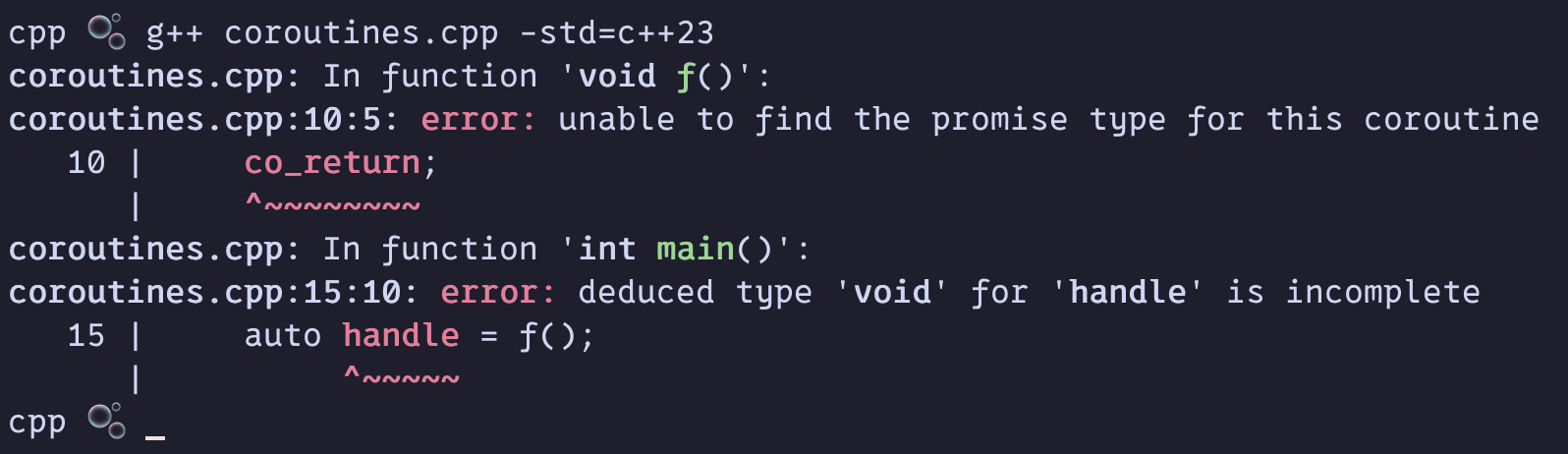
It tells us it cannot find the promise type for this coroutine. It’s not that obvious what this means. However, it’s a crucial aspect of coroutines in C++.
For coroutines to work, they must have a very specific return type.
In specific, they must return a type that has a type named exactly promise_type.
Why? Because yes. Simply by definition: it’s what the language asks from us.
1
2
3
4
5
6
7
8
9
10
11
12
13
14
15
16
#include <print>

struct MySpecialType {
  struct promise_type {};
};

MySpecialType f() {
    std::println("Hello coro");
    co_return;
}

int main() {
    std::println("Hello main");
    auto handle = f();
    return 0;
}
Let’s compile it again. Now we get a slightly less pretty error message. It complains about our promise type not implementing the methods:
get_return_objectinitial_suspendreturn_voidunhandled_exceptionfinal_suspend
Again, the compiler needs more from us: we must define these methods. One big question is: what should their signature be? Or maybe, first we should ask what their purpose is.
Let’s discuss each one: (the line numbers mentioned refer to the code above)
get_return_object: this is the method called when we call the coroutine in line 14. The value ofhandlein line 14 will be whatever this method returnsinitial_suspend: this tells the compiler if it should immediately start executing the coroutine code when it is called in line 14, or if it should not. In our example above: it tells the compiler if the execution flow should go to line 15 or to line 8return_void: this method gets called in line 9, when the coroutine returns. When a coroutine returnsvoid, the promise type must define this method. If the coroutine does not returnvoid, this method will be calledreturn_valueinstead (we will look at this case, too)unhandled_exception: this method is called if an exception is thrown and not caught within the coroutinefinal_suspend: this method is called when the coroutine ends (line 10). It tells the compiler wether it should destroy the coroutine frame or not
Just a quick note about the term coroutine frame. The state of a coroutine lives on the heap. Where state is essentially what the stack frame of a normal function would be.
Our new code is:
1
2
3
4
5
6
7
8
9
10
11
12
13
14
15
16
17
18
19
20
21
22
23
24
#include <coroutine> // needed for std::suspend_always and std::suspend_never

struct MySpecialType {
    struct promise_type {
        MySpecialType get_return_object() { return MySpecialType{*this}; }
        void return_void() noexcept {}
        std::suspend_always initial_suspend() noexcept { return {}; }
        void unhandled_exception() noexcept {}
        std::suspend_always final_suspend() noexcept { return {}; }
    };

    MySpecialType(promise_type&) {}
};

MySpecialType f() {
    std::println("Hello coro");
    co_return;
}

int main() {
    std::println("Hello main");
    auto handle = f();
    return 0;
}
This compiles, and the output is:
Hello mainNotice the return type of get_return_object(), that will be the type of handle in line 22.
Now let’s address the (maybe) cryptic std::suspend_always. It’s counterpart is std::suspend_never.
We can understand what they mean very easily by doing one small change.
Let’s change the return type of the initial_suspend() method to std::suspend_never.
Now, if we run it again we get the output:
Hello main
Hello coro
With std::suspend_never, we are telling the compiler to start executing the coroutine
immediatelly when it is called (much like how it works with functions).
In other words, in this case: std::suspend_never gives the execution flow to the body of the coroutine.
While std::suspend_always keeps the flow where it is.
This might be a good time to address final_suspend(), since at least to me it is
not as easy to grasp as inital_suspend().
As we mentioned before, final_suspend() is called when the coroutine ends, i.e falls out of scope
on line 18 in the code above. Since we are used to functions, we are used to thinking that when
the end of the scope is reached, everything in the function stack gets cleaned up and that is that.
The same is not entirely true to coroutines.
Remember that coroutines do not have a stack frame, they have a coroutine frame that lives on the heap memory (not the stack memory).
Now it makes more sense that the compiler asks us for this final_suspend() method.
Since the coroutine frame lives on the heap, what should the compiler do with this frame
once the coroutine ends? Should it free it (i.e deallocate the memory) or keep it alive?
If we want the coroutine frame to be kept alive, then we use std::suspend_always.
Otherwise, we use std::suspend_never.
This may not seem like a big deal now, and in our current code it actually is not.
But we will see later that it does matter (of course!).
For now, take a break, grab a coffee ☕️, and drink it while we appreciate how much control the language gives us over our coroutine.
Yielding a Value Out Of a Coroutine - co_yield
We now know the fundamentals. It’s time to write a slightly cooler coroutine:
MySpecialType f() {
    co_yield "Hello coro";
}
Now we don’t just print, we yield. Meaning that we want the caller of the coroutine to receive this value - much like when a function returns a value.
Also, note that we removed the co_return statement. Along with it, we also removed the
return_void() method (and the compiler did not complain).
f() is still a coroutine because it has the co_yield keyword.
Okay, let’s try to compile:
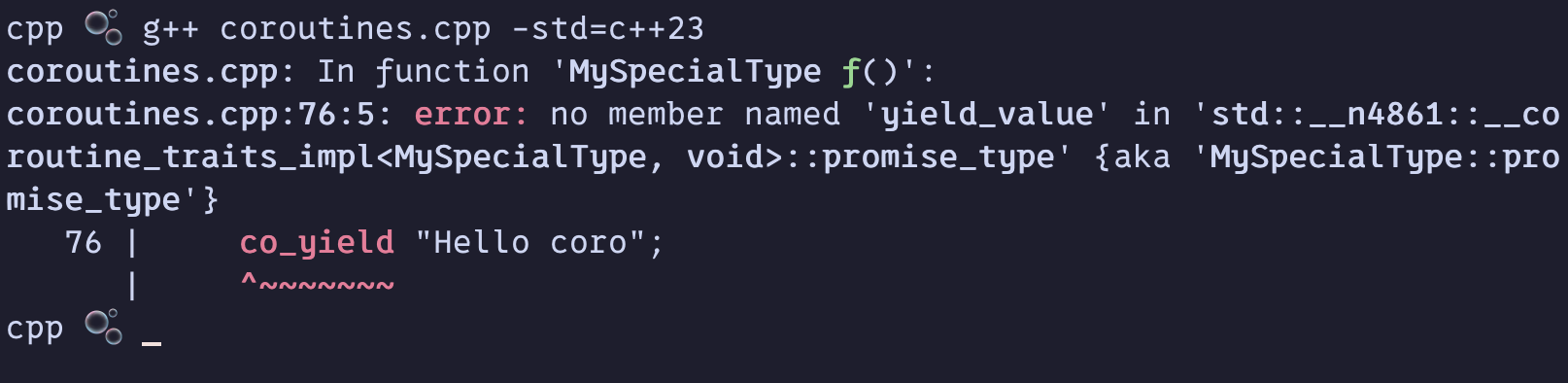
We’ve dealt with this problem before. Let’s add this method to our promise type.
std::suspend_always yield_value(std::string) noexcept { return {}; }This will be accepted by the compiler. Since we want to co_yield a string, we should have it be
the parameter of yield_value(). Lastly, with the return type we indicate wether after the co_yield
the coroutine continues to execute (std::suspend_never) or if it gives control back
to the caller (std::suspend_always). In our case, it will give back control.
The compiler will also accept other signatures, for example:
  std::suspend_always yield_value(std::string_view) noexcept { return {}; }
  std::suspend_always yield_value(const char*) noexcept { return {}; }
If we compile again, it works.
But… How does the caller access the yielded value? Our type MySpecialType must
get it from the promise type.
struct MySpecialType {
    struct promise_type {
      // ...
    };

    using HandleType = std::coroutine_handle<promise_type>;
    HandleType coro_handle_{};

    explicit MySpecialType(promise_type& prom)
      : coro_handle_{HandleType::from_promise(prom)} {}

    ~MySpecialType() {
        if (not coro_handle_.done()) coro_handle_.destroy();
    }
};
First, we must have some sort of handle in our MySpecialType that references
the promise. For our purposes, coroutine promise and coroutine frame
are sort of the same thing: we can think of it as a pointer to the coroutine’s data.
(In fact, std::coroutine_handle<T> is essentially a pointer to the coroutine frame).
Next, let’s hold the yielded value in our promise type. Why? Because with our
coro_handle_ we can get to the promise type - by doing coro_handle_.promise().{field}.
This is how our promise type looks now: (notice the field out_ and the method yield_value())
struct promise_type {
    std::string out_;

    MySpecialType get_return_object() { return MySpecialType{*this}; }
    std::suspend_always initial_suspend() noexcept { return {}; }

    std::suspend_always yield_value(std::string val) noexcept {
        out_ = std::move(val);
        return {};
    }

    void unhandled_exception() noexcept {}
    std::suspend_always final_suspend() noexcept { return {}; }
};
Finally, let’s add a method in MySpecialType to retrieve this out_ value from the promise.
We can call this method anyting we want, I will call it get().
The final code is this:
1
2
3
4
5
6
7
8
9
10
11
12
13
14
15
16
17
18
19
20
21
22
23
24
25
26
27
28
29
30
31
32
33
34
35
36
37
38
39
40
41
42
struct MySpecialType {
    struct promise_type {
        std::string out_;

        MySpecialType get_return_object() { return MySpecialType{*this}; }
        std::suspend_always initial_suspend() noexcept { return {}; }

        std::suspend_always yield_value(std::string val) noexcept {
            out_ = std::move(val);
            return {};
        }

        void unhandled_exception() noexcept {}
        std::suspend_always final_suspend() noexcept { return {}; }
    };

    using HandleType = std::coroutine_handle<promise_type>;
    HandleType coro_handle_{};

    explicit MySpecialType(promise_type& prom)
      : coro_handle_{HandleType::from_promise(prom)} {}

    ~MySpecialType() {
        if (not coro_handle_.done()) coro_handle_.destroy();
    }

    std::string get() { // may have any name
        if (not coro_handle_.done()) coro_handle_.resume();
        return std::move(coro_handle_.promise().out_);
    }
};

MySpecialType f() {
    co_yield "Hello coro";
}

int main() {
    std::println("Hello main");
    auto handle = f();
    std::println("Coroutine says: {}", handle.get());
    return 0;
}
The output is:
Hello main
Coroutine says: Hello coro
An explanation is due about line 28.
Mainly, why do we call resume on the coroutine?
We actually already have all the knowledge to know why.
Let’s go through it step by step:
- we call the coroutine in line 39, but because
initial_suspend()returnsstd::suspend_alwaysthis line is lazy - the flow of execution is kept by the main function - then we call
handle.get()in line 40 - now, we are in
get()- if line 28 did not exist and we just return the value of
out_, we would return an empty string, because the coroutine has not executed any of its body yet
- if line 28 did not exist and we just return the value of
- but line 28 exists, so we resume the coroutine - in our case, we resume it for the first time, so
in plain english it is more accurate to say we start the coroutine
- Now the flow of execution goes to the first instruction of the coroutine: line 34. This is the yield instruction, which
will essentially call the
yield_value()method in the promise type - initializingout_. - Moreover, since
yield_value()returns astd::suspend_always, the coroutine gets paused, and the flow of execution goes back to the caller (line 29). - Now, when we read from
out_, the value is actually there
- Now the flow of execution goes to the first instruction of the coroutine: line 34. This is the yield instruction, which
will essentially call the
I will take this chance to show you the importance of the return type of final_suspend().
Let’s imagine changing all std::suspend_always in the code above with std::suspend_never.
Now, when we call the coroutine in line 39, it will:
- immediately start executing
- when it hits the
co_yieldit will just keep on going to the next line - when it reaches the end of the scope in line 35 it will deallocate the coroutine frame in the heap
Essentially, it will behave like a function. So, what is the problem?
Well, now in line 40 when we call handle.get() to fetch the value, we will get
a SEGMENTATION FAULT - 2025 and still hitting these… 😑
Why? Because the coroutine frame no longer exists. A few paragraphs ago, we said that
coro_handle_ is essentially a pointer to the coroutine frame. If this frame no longer exists,
we should not use coro_handle_ anymore. And indeed the frame has been destroyed,
because our final_suspend() method returns std::suspend_never, which tell the coroutine not
to suspend/pause.
If we keep the coroutine frame alive, by only changing the return type of final_suspend() back to
std::suspend_always, it works again. Like so:
std::suspend_never initial_suspend() noexcept {...}
std::suspend_never yield_value(std::string) noexcept {...}
std::suspend_always final_suspend() noexcept {...}
Now, the end result will be the same as before, but the flow of execution will still be different - as we have just seen.
We deserve another ☕️ break by now.
Revisiting our Basic Coroutine - co_return
Before we move on to the next beast, let’s quickly look at co_return again.
In our first example, the coroutine had a print and simple empty co_return statement,
with a return type of void. This forced us to define the return_void() method
in our promise type.
What if we wanted to return something else? Let’s try the following setup:
1
2
3
4
5
6
7
8
9
10
11
12
13
14
15
16
17
18
19
20
21
22
struct MySpecialType {
    struct promise_type {
        MySpecialType get_return_object() { return MySpecialType{*this}; }
        // void return_void() noexcept {}
        std::suspend_always initial_suspend() noexcept { return {}; }
        void unhandled_exception() noexcept {}
        std::suspend_always final_suspend() noexcept { return {}; }
    };

    MySpecialType(promise_type&) {}
};

MySpecialType f() {
    std::println("Hello coro");
    co_return 10;
}

int main() {
    std::println("Hello main");
    auto handle = f();
    return 0;
}
If we compile, we get an error:
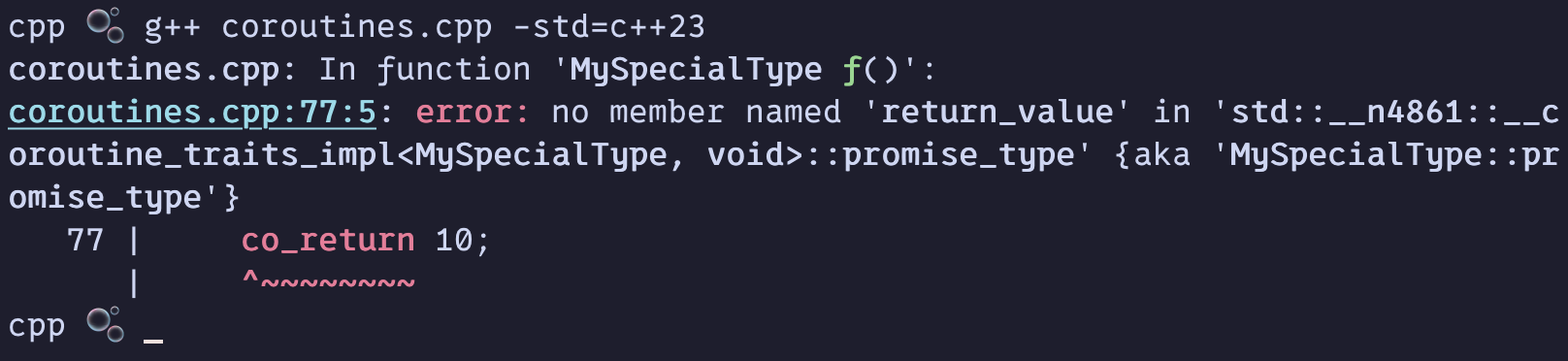
As we mentioned before, we need a method called return_value instead of return_void:
void return_value(int) noexcept {}The way we get this value out is identical to how we did it before with co_yield. We need a new int field
in our promise type, and a new method in our MySpecialType to read this value from the promise type.
Also, notice that the return type of return_value is just void. This is because after co_return
gets executed, the method final_suspend will be called to let the coroutine know if it should
suspend or not - so we do not need to specify this behavior in return_value.
Note that we used an int, but of course it can be any type.
The final code looks like this:
1
2
3
4
5
6
7
8
9
10
11
12
13
14
15
16
17
18
19
20
21
22
23
24
25
26
27
28
29
30
31
32
33
34
35
36
37
struct MySpecialType {
    struct promise_type {
        int out_;
        MySpecialType get_return_object() { return MySpecialType{*this}; }
        void return_value(int x) { out_ = x; }
        std::suspend_always initial_suspend() noexcept { return {}; }
        void unhandled_exception() noexcept {}
        std::suspend_always final_suspend() noexcept { return {}; }
    };

    using HandleType = std::coroutine_handle<promise_type>;
    HandleType coro_handle_{};

    explicit MySpecialType(promise_type& prom)
      : coro_handle_{HandleType::from_promise(prom)} {}

    ~MySpecialType() {
        if (not coro_handle_.done()) coro_handle_.destroy();
    }

    int get() {
        if (not coro_handle_.done()) coro_handle_.resume();
        return coro_handle_.promise().out_;
    }
};

MySpecialType f() {
    std::println("Hello coro");
    co_return 10;
}

int main() {
    std::println("Hello main");
    auto handle = f();
    std::println("Coroutine co_returned {}", handle.get());
    return 0;
}
And the output is:
Hello coro
Coroutine co_returned 10
Before we move on. Let’s revisit our discussion about the importance of the return type of final_suspend.
Previously, we established that this method tells the compiler wether to deallocate the coroutine frame or not.
Let me add another, and the last piece of information, so we are fully aware of how things work.
Independently of the return type we choose for final_suspend, once the coroutine reaches the end of the scope,
all local variables it contains will be destroyed - much like when a function ends.
The devil is in the details: only the state of the promise depends on the return value of final_suspend.
The local variables of the coroutine always get cleaned up at the end of the scope.
This is, more often than not, a technicality. But it is good to know. For example, now you know that even if you
have std::suspend_always final_suspend() {...}, you should not keep any pointers in your promise
to any local local variables in the finished coroutine.
Getting a Value Into the Coroutine - co_await
Finally, we will talk about `co_await’.
As usual, let’s just add a co_await to our code and see what the compiler tells us.
1
2
3
4
5
6
7
8
9
10
11
12
13
14
15
16
17
18
19
20
21
22
23
24
25
26
27
28
29
struct MySpecialType {
    struct promise_type {
        MySpecialType get_return_object() { return MySpecialType{*this}; }
        std::suspend_always initial_suspend() noexcept { return {}; }
        void unhandled_exception() noexcept {}
        std::suspend_always final_suspend() noexcept { return {}; }
    };

    using HandleType = std::coroutine_handle<promise_type>;
    HandleType coro_handle_{};

    explicit MySpecialType(promise_type& prom)
      : coro_handle_{HandleType::from_promise(prom)} {}

    ~MySpecialType() {
        if (not coro_handle_.done()) coro_handle_.destroy();
    }
};

MySpecialType f() {
    auto in = co_await std::string{};
    std::println("Coroutine received {}", in):
}

int main() {
    std::println("Hello main");
    auto handle = f();
    return 0;
}
Compiling gives us the error:
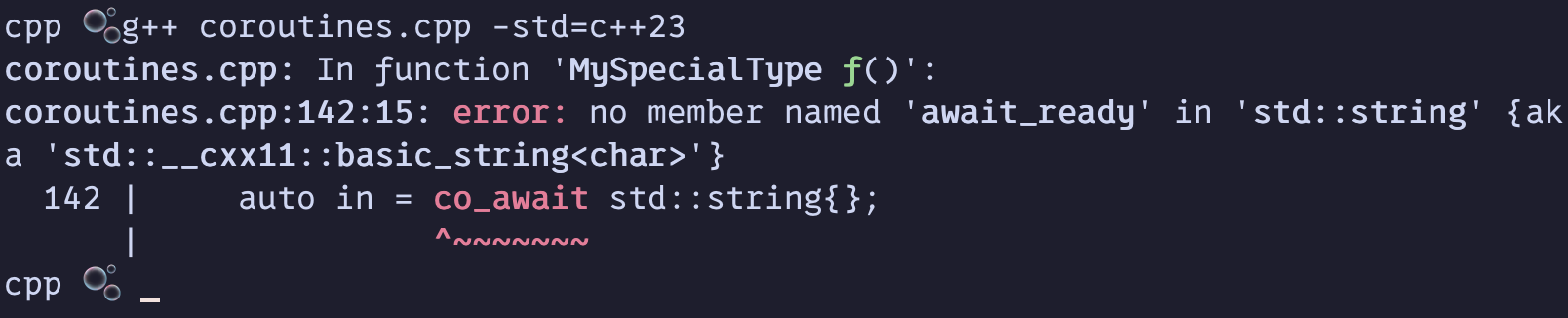
This one is a bit more cryptic. It indicates that something is missing in the type std::string itself.
I was expecting something like:
missing method 'await_value' in promise_typeAs it happens, the method we need to define in order to use co_await is slightly less nice than the others.
Let’s go step by step. Indeed, we can solve this error by adding another method to our promise type:
auto await_transform(auto) noexcept { ... }But what should its signature be? This one is hard to guess. But we at least know 2 things:
- we want to be able to tell the compiler if before the
co_awaitit should suspend always or never. - we want to receive a std::string.
Before we go any further, let me assure you that if you think this is annoying you are not alone. Why is await not as simple as the other methods? Well, let’s write it the way we want to and try to spot the issue.
std::suspend_always await_value(std::string s) noexcept {
  // what to do with 's' ?
  return {};
}
Remember that when the compiler sees co_await it will replace it by a call to our await_value method,
so it should return a std::string. But, if it returns a std::string it cannot return std::suspend_always.
This is the problem, we need more than a single function.
The proper way to do it is as follows:
auto await_transform(std::string) noexcept {
    struct awaiter { // we can name this type whatever we want
        promise_type& promise;
        bool await_ready() const noexcept { return true; }
        std::string await_resume() const noexcept { ... }
        void await_suspend(HandleType) const noexcept {}
    };

    return awaiter{*this};
}
We do need all these methods to make co_await_ work. Let’s look at each one individually.
await_ready: this method is called when the execution flow hits theco_awaitinstruction. If it returnstrue, the coroutine will not pause - i.e it will consider that the value it was awaiting for is already ready to be consumed. If it returns `false’, it will pause and give up the flow control. (we will come back to this, don’t worry 😉)await_resume: this method is called when the coroutine wants to fetch the value it is awaiting for. After it consumes the value, it keeps on executing.await_suspend: this method is only called ifawait_readyreturnsfalse. Its argument is the handle to the coroutine. Its return type can bevoidorstd::coroutine_handle<>- this is very interesting and powerful, we will discuss it shortly.
Oh! By the way… We just implemented our own std::suspend_never/std::suspend_always.
Really! Check what the standard says about these types: std::suspend_never 🔗
and std::suspend_always 🔗 - note the 3 methods they define.
Also, note that the only difference between them is the return value of the method await_ready.
The standard library developers got nothing on us. 😎
Finally, we need to return a string from await_resume.
This requires communication between the handle and the coroutine. We have done this before.
The final code is below.
Notice the methods MySpecialType::put and await_ready, and what we do in main().
1
2
3
4
5
6
7
8
9
10
11
12
13
14
15
16
17
18
19
20
21
22
23
24
25
26
27
28
29
30
31
32
33
34
35
36
37
38
39
40
41
42
43
44
45
46
47
48
49
50
51
struct MySpecialType {
    struct promise_type {
        std::string in_;

        MySpecialType get_return_object() { return MySpecialType{*this}; }
        std::suspend_always initial_suspend() noexcept { return {}; }

        auto await_transform(std::string) noexcept {
            struct awaiter {
                promise_type& promise;
                bool await_ready() const noexcept { return true; }
                std::string await_resume() const noexcept {
                  return std::move(promise.in_);
                }
                void await_suspend(HandleType) const noexcept {}
            };

            return awaiter{*this};
        }

        void unhandled_exception() noexcept {}
        std::suspend_always final_suspend() noexcept { return {}; }
    };

    using HandleType = std::coroutine_handle<promise_type>;
    HandleType coro_handle_{};

    explicit MySpecialType(promise_type& prom)
      : coro_handle_{HandleType::from_promise(prom)} {}

    ~MySpecialType() {
        if (not coro_handle_.done()) coro_handle_.destroy();
    }

    void put(std::string s) { // can be named anything
        coro_handle_.promise().in_ = std::move(s);
        if (not coro_handle_.done()) coro_handle_.resume();
    }
};

MySpecialType f() {
    auto val = co_await std::string{};
    std::println("{}", val);
}

int main() {
    std::println("Hello main");
    auto handle = f();
    handle.put("Hello coro");
    return 0;
}
Let’s make sure we really, really understand what is going on here.
Look at line 47: this is a lazy line, because initial_suspend returns std::suspend_always.
Look also at the method await_ready: we are returning true, which means that when the execution flow
reaches the co_await instruction it will not actually wait. It will immediately invoke await_resume
and continue executing - so we must ensure we have already initialized in_ when we reach the co_await.
This is why in put() we first initialize in_, and only then resume (in our case, start)
the coroutine.
That’s pretty much it, elementary.
Some More Details So You Can Have Even More Fun
- In one single coroutine, we can
co_yieldmany types. All we have to do is overload the methodyield_value, for example:
std::suspend_always yield_value(std::string) noexcept { ... }
std::suspend_always yield_value(std::vector) noexcept { ... }-
And the same goes to values we
co_await, we just need to overloadawait_transform. - In the method
await_suspendinsideawait_transform, we can return two different types:- by returning
void, we give control back to the caller - or we can return a handle to another coroutine - handle type is
std::coroutine_handle<>- and now we pass control (i.e the execution flow) to that coroutine instead
- by returning
- If your coroutines has parameters, you can also receive them in your promise type. Just write a constructor that takes in the same parameter list.
References
Videos on Youtube:
- C++20’s Coroutines for Beginners - Andreas Fertig - CppCon 2022 🔗
- Deciphering C++ Coroutines - A Diagrammatic Coroutine Cheat Sheet - Andreas Weis - CppCon 2022 🔗
Books:
- Chapter 8 of ‘Asynchronous Programming with C++’ by Javier Reguera-Salgado and Juan Antonio Rufes